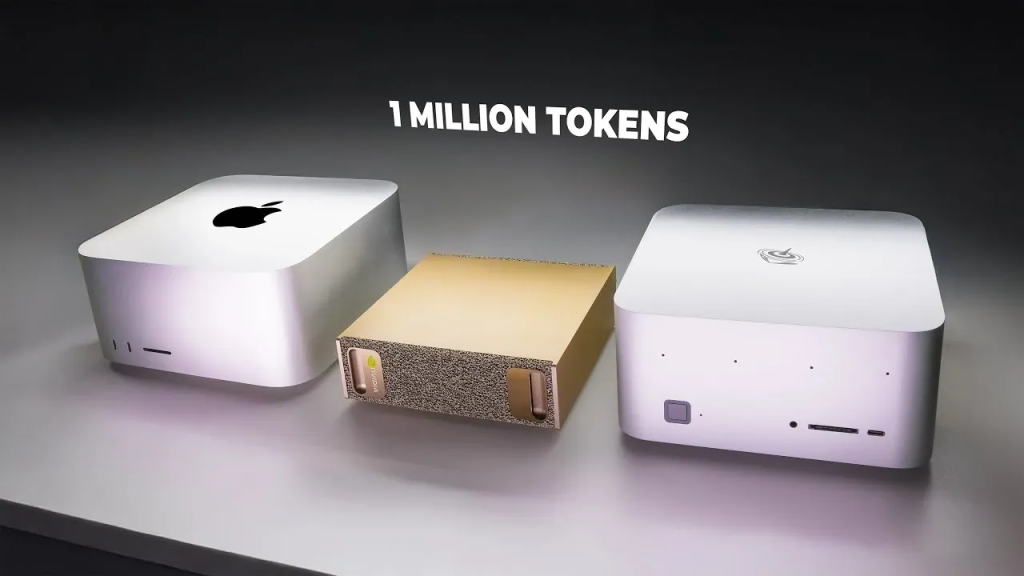


TL;DR Key Takeaways:
- DGX Spark is the fastest and most energy-efficient system, ideal for high-throughput tasks, but requires a significant financial investment.
- AMD Radeon 960 XT offers a budget-friendly option with competitive performance and low energy consumption, suitable for smaller-scale operations.
- Mac Studio M3 Ultra excels in idle energy efficiency but is slower and less efficient during intensive tasks, making it better for energy-conscious users.
- Software optimization plays a critical role, with tools like VLM excelling in concurrency for Nvidia and AMD hardware, and MLX optimized for Apple Silicon.
- H200 Cluster delivers unmatched speed for enterprise-level tasks but at a high energy and financial cost, suitable only for users with substantial computational demands.
The Quest for Speed, Efficiency, and Cost-Efficiency in Token Generation
When it comes to generating 1 million AI tokens in the shortest time possible, the DGX Spark, AMD Radeon 960 XT, and Mac Studio M3 Ultra offer distinct advantages, each suited to different computing needs. This in-depth analysis explores how each system performs under the pressure of generating tokens and examines the trade-offs between speed, energy efficiency, and cost. These findings are not just about numbers—they’re about practical, real-world performance when working with complex AI models.
Test Setup: Hardware and Software Overview
To conduct a fair and comprehensive comparison, five systems were put to the test:
- AMD Radeon 960 XT: Budget-friendly GPU ideal for moderate workloads.
- DGX Spark: A high-performance system tailored for demanding computational tasks.
- Beink GTR9 (AMD Strix Halo): A compact system designed to balance affordability and performance.
- Mac Studio M3 Ultra: Apple’s premium offering, built for energy efficiency and creative workflows.
- H200 Cluster: A large-scale system designed for enterprise-level tasks.
For testing, these systems were tasked with generating 1 million tokens using the Quen 3 4B model, a compact AI model with 4 billion parameters that is compatible with diverse platforms. A mix of software tools such as Llama CPP, VLM, and MLX were employed, focusing on concurrency and cross-platform functionality to maximize performance across the systems.
Performance Results: Speed, Energy, and Efficiency
When tasked with generating 1 million tokens, the results revealed the distinct strengths and weaknesses of each system:
1. DGX Spark:
- Speed: Completed the task in just 6.7 minutes, generating 2,451 tokens per second.
- Energy Efficiency: Exceptional, with minimal energy consumption considering its high performance.
- Use Case: Ideal for large-scale, high-throughput environments where time is crucial.
2. AMD Radeon 960 XT:
- Speed: Finished the task in 8.12 minutes, generating 1,913 tokens per second.
- Energy Efficiency: Very efficient, offering a good balance between performance and power usage.
- Use Case: A budget-friendly choice for moderate workloads, offering solid performance without breaking the bank.
3. Mac Studio M3 Ultra:
- Speed: Took 26 minutes to generate 1 million tokens, considerably slower than the other systems.
- Energy Efficiency: Highly efficient in idle state, making it the best choice for users prioritizing low power consumption.
- Use Case: Best for users looking for an energy-efficient system who aren’t in urgent need of ultra-fast processing.
4. Beink GTR9:
- Speed: The slowest of the group, completing the task in 34 minutes.
- Energy Efficiency: While the system offers good energy management, its performance lag means it isn’t ideal for high-demand tasks.
- Use Case: Suitable for casual users or smaller-scale operations, though it falls short for more demanding tasks.
5. H200 Cluster:
- Speed: Delivered an impressive 2,609 tokens per second when tested with a 480-billion-parameter model, outpacing the DGX Spark.
- Energy Efficiency: Significantly higher energy consumption, making it the least efficient in terms of power use.
- Use Case: Best suited for enterprise-level users who need the highest performance, with the trade-off of higher energy and financial costs.
Conclusion: Performance vs Cost vs Sustainability
The test results reveal the nuances of selecting the right system for token generation:
- DGX Spark remains the leader for speed and efficiency but requires a significant financial investment, making it ideal for high-demand environments with substantial resources.
- AMD Radeon 960 XT is an excellent budget choice for users seeking solid performance without the steep costs, offering great value for those with moderate workloads.
- Mac Studio M3 Ultra, though energy-efficient, struggles with speed under intense workloads, positioning it as a more suitable option for non-time-sensitive tasks where energy consumption is prioritized.
- Beink GTR9 may not be the fastest, but it offers an entry-level solution for smaller-scale operations and users who don’t need to process tokens at lightning speed.
- The H200 Cluster, while unparalleled in raw speed, is better suited for enterprise-level operations that can afford its high energy and financial costs.
For users looking to balance speed, efficiency, and cost, the AMD Radeon 960 XT offers the best value, especially for smaller businesses or personal projects. Meanwhile, professionals or enterprises requiring top-tier performance and have the resources to support it should consider DGX Spark or the H200 Cluster.