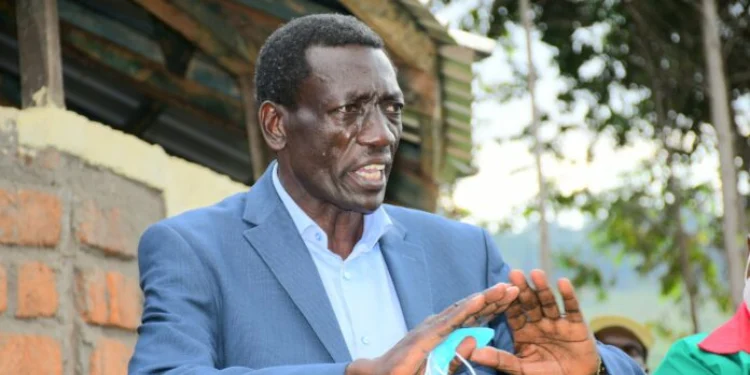

Collins Oyuu has become a central figure in Kenya’s education sector through his leadership of the Kenya National Union of Teachers. As Secretary General of KNUT, Collins Oyuu occupies a role that places him at the intersection of policy negotiation, labor advocacy and public education reform. His rise within the union reflects both steady institutional involvement and long term engagement with grassroots teaching communities.
Born in 1965 in Uyoma, Rarieda, Siaya County, Oyuu’s trajectory mirrors that of many educators who transitioned from classroom teaching into union leadership. However, his ascent to national prominence was shaped by consistent involvement in branch level representation before reaching the highest office within KNUT.
His unopposed election as Secretary General marked a significant moment for the union. It followed years of service within its executive structures and came at a time when teacher employment terms, recruitment reforms and collective bargaining agreements were under national scrutiny.
Educational Background of Collins Oyuu
Early Schooling and Seminary Studies
Collins Oyuu began his primary education in 1972 at Kasarani Primary School. His early academic journey included a brief period at the Kenya Police Training College in 1983, reflecting an exploratory phase before he fully committed to the teaching profession.
He later pursued seminary studies at Queen of Apostles in Mabanga, where he spent several years. Although he did not remain within the seminary path, the period contributed to his formative development, particularly in leadership discipline and structured community engagement.
Teacher Training and Higher Education
In 1987, Oyuu enrolled at Shanzu Teachers Training College in Kilifi, where he formally trained as a teacher. This marked the beginning of his professional commitment to education.
He later advanced his academic qualifications by undertaking a Bachelor of Education degree. The academic foundation strengthened his understanding of pedagogy and educational policy, both of which would later inform his work in union leadership.
Career Progression Within KNUT
Early Teaching and Branch Leadership
Collins Oyuu began his teaching career at Ruma Primary School in Siaya County. His engagement with union matters began in 1996 when he was elected as a branch executive committee member in Siaya. This entry point into KNUT leadership introduced him to the organizational mechanics of labor representation.
In 2002, he was elected Chairperson of the Bondo Branch. Six years later, in 2008, he became Secretary of the Rarieda Branch. These roles positioned him closer to policy discussions and collective bargaining processes at regional levels.
National Leadership Roles
In 2013, Oyuu joined the KNUT National Steering Committee. He later served as Acting Assistant Secretary General and was confirmed in that position in 2015. His steady advancement culminated in his election as KNUT Vice Chairperson in 2018.
Eventually, he assumed the role of Secretary General, replacing Wilson Sossion. His election unopposed signaled internal consensus within the union’s leadership structures.
Beyond KNUT, Collins Oyuu was appointed in October 2023 as a member of the Kenya National Qualifications Board. This appointment extended his influence beyond union advocacy into national policy frameworks that govern academic standards and qualifications.
Collins Oyuu’s Role in Education Policy Negotiations
Advocacy for Junior Secondary School Teachers
One of Oyuu’s prominent policy positions has been advocacy for the confirmation of Junior Secondary School interns on permanent and pensionable terms. He has publicly called for the recruitment and formal absorption of teachers into government payroll structures.
This stance aligns with broader debates on employment security, teacher morale and institutional capacity within Kenya’s education system. By championing permanent positions, he underscores the union’s focus on stability and long term workforce planning.
Collective Bargaining Agreements and Salary Reforms
Collins Oyuu also played a visible role in negotiations that led to the implementation of salary increments under the 2025–2029 Collective Bargaining Agreement. The salary adjustments, effective July 2025, followed sustained engagement between union officials and government representatives.
Collective bargaining remains a central mechanism through which KNUT influences employment terms. Under Oyuu’s tenure, the union continued to emphasize dialogue, structured negotiation and policy compliance.
Family Background and Personal Life
Beyond his professional commitments, Collins Oyuu maintains a relatively private personal life. He is married and has three children, comprising two sons and a daughter.
While union leadership often requires extensive public engagement, Oyuu has maintained a focus on institutional issues rather than personal publicity. This balance reflects a leadership style centered on organizational continuity rather than individual prominence.
Net Worth and Financial Disclosure Context
Public discussions frequently include references to net worth when profiling national figures. However, Collins Oyuu’s exact net worth has not been publicly disclosed through official filings. As a long serving educator and union leader, his income is generally derived from professional service within the education sector and union structures.
In Kenya, trade union officials do not routinely publish detailed personal financial statements unless required under specific public service regulations. Therefore, available information focuses primarily on his career and institutional contributions rather than private financial metrics.
Leadership Style and Institutional Continuity
Collins Oyuu’s leadership within KNUT reflects gradual institutional progression rather than abrupt political repositioning. His career path moved through branch representation, regional leadership and national executive roles before culminating in the Secretary General position.
Such continuity often strengthens organizational memory. Leaders who rise through internal structures tend to maintain familiarity with both grassroots concerns and national policy frameworks.
In a sector where education reforms frequently intersect with political and fiscal constraints, union leadership requires negotiation skills and policy literacy. Oyuu’s academic background in education and governance complements his practical union experience.
Collins Oyuu and the Future of Teacher Representation
As Kenya’s education system continues to evolve, the role of KNUT remains significant. Issues such as curriculum reform, teacher recruitment, remuneration frameworks and institutional accountability remain central to national discourse.
Collins Oyuu’s tenure places him within ongoing conversations about sustainable education financing and teacher welfare. His advocacy for permanent employment structures and negotiated salary adjustments signals a focus on stability within the profession.
Ultimately, his profile illustrates a career built on long term engagement with education policy and labor representation. From classroom teaching in Siaya County to national union leadership, Collins Oyuu’s journey reflects the layered structure of Kenya’s teacher advocacy landscape.