

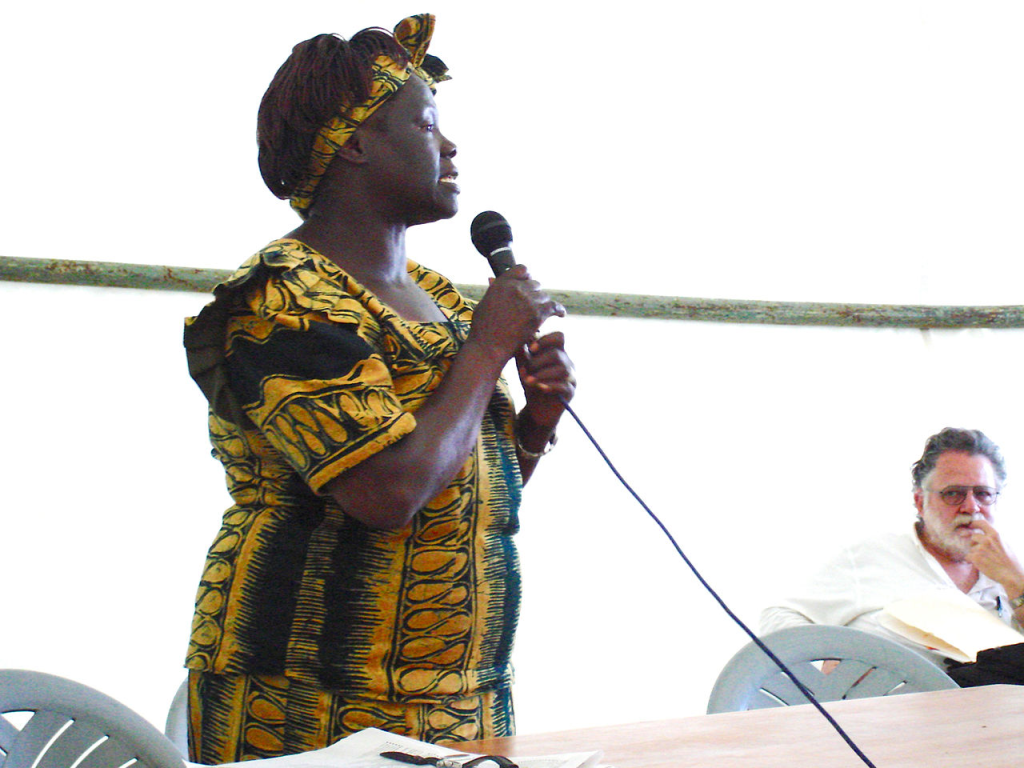
Wangarĩ Maathai remains one of the most influential figures in modern African history, not only for her environmental work but also for her contribution to democracy, human rights, and social justice. Her life story illustrates how ecological protection, political freedom, and community empowerment can intersect to produce lasting change. Through grassroots activism and intellectual leadership, Wangarĩ Maathai reshaped how environmental conservation is understood in both local and global contexts.
Born in rural central Kenya, Wangarĩ Maathai rose from modest beginnings to become an internationally respected voice on sustainable development. Her approach to activism was deeply rooted in lived experience. She listened to rural women, understood their daily struggles, and translated those realities into structured action that addressed environmental degradation and social inequality at the same time.
Wangarĩ Maathai’s work challenged the idea that environmentalism was a luxury concern. Instead, she framed it as a necessity tied to food security, clean water, peace, and dignity. By linking deforestation to poverty and political exclusion, she created a new language of environmental democracy that resonated far beyond Kenya’s borders. Her ideas influenced policy debates, academic discourse, and community organizing across Africa and the wider world.
Her legacy is inseparable from the Green Belt Movement, yet her impact extends well beyond tree planting. Wangarĩ Maathai demonstrated that ordinary citizens, particularly women, could shape national conversations and hold governments accountable. Her life offers insight into how environmental action can become a pathway to social transformation.
Early life and formative influences
Wangarĩ Maathai was born on 1 April 1940 in Ihithe, a rural village in Kenya’s central highlands. She grew up in a farming community where land, forests, and water were central to daily life. These early experiences shaped her understanding of the natural environment as a source of both livelihood and identity.
As a child, she witnessed changes in land use brought about by colonial agriculture. Indigenous forests were cleared, rivers became polluted, and traditional farming systems were disrupted. Although she did not yet articulate these changes in political terms, they left a lasting impression that later informed her environmental consciousness.
Her early education took place in local mission schools, where she excelled academically. Exposure to formal schooling during a period of political upheaval also introduced her to broader questions about justice, authority, and social responsibility. These formative years laid the groundwork for her later engagement with both science and activism.
Education and academic achievement
Wangarĩ Maathai’s academic journey was remarkable, particularly at a time when higher education opportunities for African women were limited. She was among the Kenyan students selected to study abroad through the Kennedy Airlift program, which aimed to prepare young Africans for leadership roles after independence.
She pursued undergraduate studies in the United States, focusing on biological sciences. During her time abroad, she encountered environmental restoration efforts in urban America, experiences that broadened her understanding of ecological recovery and public advocacy. These observations later influenced her belief that damaged environments could be restored through collective effort.
After completing her master’s degree, Wangarĩ Maathai returned to Kenya and continued her academic work. She became the first woman in East and Central Africa to earn a doctoral degree, a milestone that challenged gender norms within academia. Her achievement also positioned her as a role model for young women aspiring to careers in science and public service.
Her academic career at the University of Nairobi progressed steadily. She broke multiple barriers, becoming the first woman to hold senior academic leadership positions within the institution. At the same time, she advocated for gender equality in employment conditions, linking professional fairness to broader social reform.
The roots of environmental activism
Wangarĩ Maathai’s activism emerged gradually through her involvement in civic organizations. While working with women’s groups and community associations, she began to notice recurring concerns about firewood scarcity, soil erosion, and declining agricultural productivity. These environmental problems were deeply connected to economic hardship and social instability.
She recognized that environmental degradation was not an isolated issue but part of a larger system shaped by governance, land policy, and development priorities. This realization marked a turning point in her work, as she sought practical solutions that addressed both ecological and social needs.
Her early initiatives focused on community participation. Rather than imposing external models, she encouraged local action rooted in indigenous knowledge. This approach later became a defining feature of her work and helped build trust among rural communities.
Founding the Green Belt Movement
In 1977, Wangarĩ Maathai founded the Green Belt Movement, an initiative that combined environmental restoration with women’s empowerment. The movement encouraged women to plant trees, restore degraded land, and protect local ecosystems. Participants received small stipends, creating income opportunities alongside environmental benefits.
The Green Belt Movement grew rapidly, spreading across Kenya and later throughout Africa. Its success lay in its simplicity and adaptability. Tree planting addressed immediate needs such as firewood and water conservation while also fostering long-term ecological resilience.
Beyond its environmental impact, the movement became a platform for civic education. Workshops and seminars emphasized community responsibility, democratic participation, and accountability. Wangarĩ Maathai believed that environmental sustainability could not be separated from good governance and social justice.
Confrontation with political power
As the Green Belt Movement gained visibility, it increasingly came into conflict with state authorities. Wangarĩ Maathai openly criticized government policies that promoted deforestation, land grabbing, and exclusionary development. Her opposition to construction projects in public green spaces brought her into direct confrontation with political elites.
She faced harassment, arrest, and public vilification. Despite these pressures, she remained steadfast, framing her resistance as a defense of public interest rather than personal opposition. Her courage drew international attention and transformed local environmental disputes into global symbols of democratic struggle.
Wangarĩ Maathai’s activism during this period illustrated the risks faced by civil society actors in authoritarian contexts. Yet it also demonstrated the power of sustained, principled resistance grounded in moral clarity and community support.
Role in Kenya’s democratic movement
Wangarĩ Maathai’s environmental activism evolved into broader political engagement during Kenya’s struggle for multiparty democracy. She collaborated with other reform advocates to demand fair elections, constitutional reform, and respect for human rights.
Her participation in protests and civic campaigns highlighted the interconnectedness of environmental protection and democratic governance. She argued that environmental destruction often thrived under unaccountable systems, making political reform essential for sustainability.
Although she faced setbacks and personal costs, her persistence contributed to gradual political change. Her leadership during this period reinforced her reputation as a national figure committed to justice and inclusion.
Parliamentary service and public leadership
In the early 2000s, Wangarĩ Maathai entered formal politics. She was elected to Kenya’s parliament and later appointed to a ministerial role focused on environmental affairs. Her transition from activist to public official reflected a broader shift toward institutional engagement.
In government, she promoted conservation policies and supported community-based resource management. While navigating the constraints of political office, she continued to advocate for transparency and environmental responsibility.
Her parliamentary career underscored the possibility of translating grassroots activism into policy influence, even within complex political systems.
International recognition and the Nobel Peace Prize
Wangarĩ Maathai’s global influence was affirmed when she received the Nobel Peace Prize in 2004. She was the first African woman to be awarded the prize, recognized for linking environmental sustainability with peace and democracy.
The award highlighted her innovative approach to peacebuilding, which emphasized ecological stability as a foundation for social harmony. Her recognition elevated environmental issues within international peace discourse and inspired activists worldwide.
Following the Nobel Prize, she continued to engage in global initiatives, promoting reforestation, climate action, and women’s leadership across continents.
Later life and enduring legacy
In her later years, Wangarĩ Maathai remained active as a writer, speaker, and mentor. She published works reflecting on Africa’s development challenges and the ethical dimensions of environmental stewardship. Her ideas continued to influence policy debates and educational programs.
She passed away in 2011 after a prolonged illness, but her legacy endures through institutions, awards, and community projects bearing her name. The Green Belt Movement continues its work, planting millions of trees and empowering new generations.
Wangarĩ Maathai’s life demonstrates how environmental care can serve as a foundation for justice, peace, and democratic participation. Her story remains relevant as societies confront climate change, inequality, and governance challenges.
Honours
- 1984: Right Livelihood Award
- 1986: Better World Society
- 1987: Global 500 Roll of Honour
- 1991: Goldman Environmental Prize
- 1991: The Hunger Project‘s Africa Prize for Leadership[104]
- 1993: Edinburgh Medal (for “Outstanding contribution to Humanity through Science”)
- 1993: Jane Addams Leadership Award
- 1993: Benedictine College Offeramus Medal[105]
- 1994: The Golden Ark Award
- 2001: The Juliet Hollister Award
- 2003: Global Environment Award, World Association of Non-Governmental Organizations
- 2004: Conservation Scientist Award from Columbia University
- 2004: J. Sterling Morton Award
- 2004: Petra Kelly Prize
- 2004: Sophie Prize
- 2004: Nobel Peace Prize
- 2006: Légion d’honneur
- 2006: Doctor of Public Service (honorary degree), University of Pittsburgh[106]
- 2007: World Citizenship Award
- 2007: Livingstone Medal from Royal Scottish Geographical Society
- 2007: Indira Gandhi Prize
- 2007: Cross of the Order of St. Benedict[105]
- 2008: The Elizabeth Blackwell Award from Hobart and William Smith Colleges
- 2009: NAACP Image Award – Chairman’s Award (with Al Gore)[107][108]
- 2009: Grand Cordon of the Order of the Rising Sun of Japan[109][110]
- 2011: The Nichols-Chancellor’s Medal awarded by Vanderbilt University[111]
- 2013: Doctor of Science (honorary degree), Syracuse University, New York[112]
- 2020: The Perfect World Award by The Perfect World Foundation