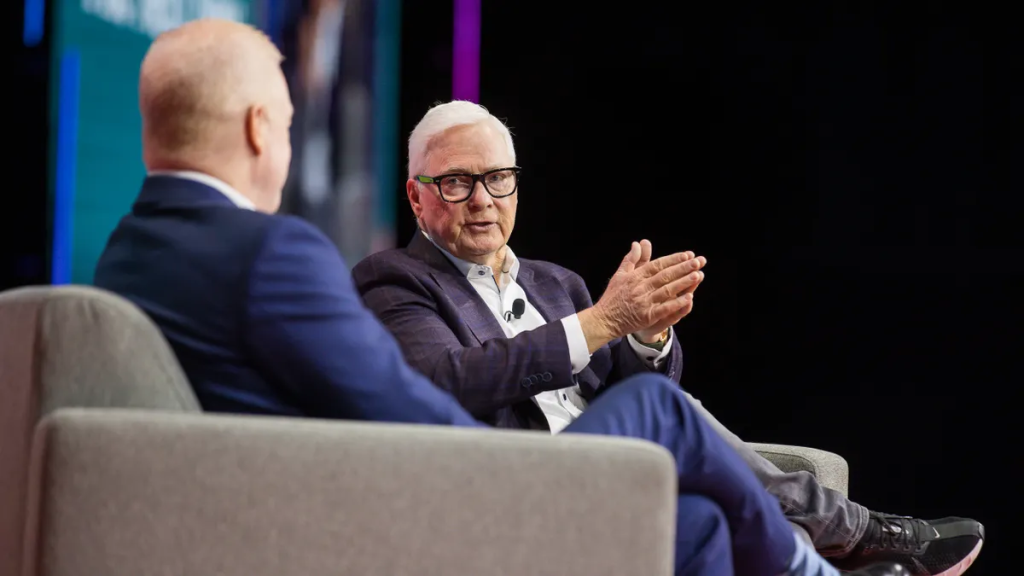


New York, NY – At the National Retail Federation’s 2026 Big Show, retail executives from major brands like Macy’s, Target, and Dick’s Sporting Goods gathered to discuss the rapid evolution of artificial intelligence (AI) and its impact on the retail industry. As AI tools become integral to business operations, executives shared their thoughts on how this technology will shape the future of shopping, customer experience, and internal processes.
The panel discussions underscored the belief that AI is not just a tool, but a powerful enabler of growth and innovation. Retailers are increasingly using AI to enhance customer experiences, optimize operations, and improve product offerings, but they also recognize the importance of collaboration in integrating these systems effectively.
AI as an Enabler, Not a Strategy
Max Magni, Chief Customer and Digital Officer at Macy’s, emphasized that AI should not be viewed as a standalone strategy. “AI is an enabler,” he said, noting its potential to improve how brands listen to and engage with their customers. AI, according to Magni, is a tool to help retailers better understand consumer behavior and refine their offerings.
Similarly, Ed Stack, Executive Chairman of Dick’s Sporting Goods, reassured the audience that AI should not be feared. “It’s going to have an impact, for sure, but it’s also going to create some other opportunities on the other side,” Stack said. His optimistic outlook highlights the idea that AI can open doors for innovation, even as it disrupts traditional business models.
AI in Retail Journeys: A Game Changer
Mary Beth Laughton, CEO of REI, underscored the importance of AI in transforming every aspect of the retail journey. “I’m a believer that AI is going to touch every aspect of our retail business,” she explained, suggesting that its integration could revolutionize how businesses interact with customers at every touchpoint.
Prat Vemana, Chief Information and Product Officer at Target, echoed similar sentiments, cautioning companies not to implement AI simply for the sake of innovation. “Know your business, know your roadmap, and apply [AI] for the right reasons,” he advised, emphasizing that AI should be leveraged strategically to meet specific business goals rather than as a generic solution.
AI and Human Interaction: The Perfect Partnership
Kecia Steelman, CEO of Ulta Beauty, shared her belief in the synergy between AI and human expertise. “AI, partnered with human interaction and the knowledge base we have, is going to make a really big difference,” she said, stressing that AI should complement, rather than replace, human intelligence.
Billy May, CEO of Brooklinen, took a forward-thinking approach, noting, “The only way to predict the future is to be a part of it.” He stressed that retailers not exploring AI integration risk falling behind competitors in an industry increasingly defined by technological innovation.
The Pace of AI Adoption: Thoughtful or Rapid?
While some executives, like Magni, embraced the idea of moving quickly with AI, others cautioned against rushing the process. Josh Krepon, President of U.S. DTC and Global Digital at Steve Madden, argued that it is wiser to adopt AI thoughtfully and at a measured pace. “It makes more sense to move thoughtfully and slow than faster, like the fail-fast mentality,” Krepon said, highlighting the importance of careful implementation.
AI to Amplify Creativity, Not Replace It
BJ’s CEO Bob Eddy focused on AI’s role in amplifying creativity. “Retail will keep advancing in AI, not to replace creativity, but to amplify it,” Eddy said, adding that AI could unlock new possibilities in merchandising, design, forecasting, and supply chain management. According to Eddy, AI will accelerate the industry’s ability to create and innovate, especially in areas traditionally driven by human creativity.
Human-Centered Innovation
Emma Grede, co-founder and CEO of Good American, and founding partner of Skims, shared a perspective on AI that highlights its role in freeing up time for human-centered tasks. “It’s not about taking anything human out of what we do,” Grede explained. “It’s actually leaving ourselves the time to do the stuff that only we can do.” This sentiment reflects a broader understanding that AI can handle routine tasks, allowing humans to focus on innovation, creativity, and strategic decision-making.
As AI continues to permeate the retail industry, it’s clear that retailers view the technology as both a challenge and an opportunity. The key takeaway from these discussions is that AI, when implemented thoughtfully and in partnership with human expertise, has the potential to reshape the future of retail—enhancing customer experiences, driving efficiencies, and fostering innovation across all aspects of the business.