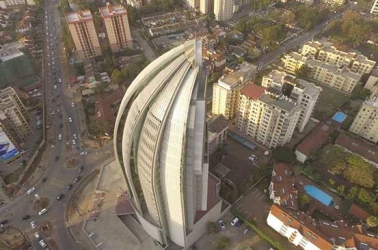


Nyayo House, located at the intersection of Uhuru Highway and Kenyatta Avenue in Nairobi, is one of the most iconic and controversial buildings in Kenya. Standing at 84 meters and with 27 floors, the skyscraper is a prominent feature of Nairobi’s skyline. Completed in 1983, Nyayo House serves as the headquarters for several government departments, including the State Department for Immigration, Border Control, and Regulation of Persons. Despite its modern architectural design, Nyayo House is also infamous for its dark history, particularly its association with political repression during the regime of President Daniel arap Moi.
Originally planned in the 1970s and constructed under the leadership of President Moi, Nyayo House became a symbol of the government’s power, both physically and politically. While it has remained a key government building in Nairobi, its history is marred by its role in the torture and detention of political dissidents during Kenya’s post-independence years. The building’s significance goes beyond its role in government functions, as it embodies a turbulent period in the country’s history. In recent years, Nyayo House has become the subject of investigations, public debate, and calls for acknowledgment of its past.
Design and Structure: A Symbol of Power
Nyayo House was designed with functionality in mind, housing multiple government departments within its 27 floors. At 84 meters high, it was one of Nairobi’s tallest buildings when completed and remains one of the most recognizable. Its modernist design features clean lines and glass facades, making it a fitting reflection of Kenya’s aspirations during the era of its construction.
The building was commissioned by the Ministry of Public Works and constructed by Laxmanbhai Construction, with the architectural design led by Ngotho Architects. Nyayo House was initially intended to be named Nairobi House, symbolizing its status as the center of government in the city. However, it was later renamed to Nyayo House, in line with the Moi administration’s political branding—”Nyayo” meaning footsteps in Swahili, symbolizing the president’s legacy.
Nyayo House has a multi-functional structure that includes office spaces, government offices, and meeting rooms. Its design maximized the limited space on its plot, ensuring that the building could accommodate a significant number of government departments while also maintaining its imposing presence.
Political and Historical Significance: The “Torture Chambers”
Despite its grand design, Nyayo House is most infamous for its association with political repression. During President Moi’s rule, the basement of the building was used as a detention facility for political prisoners, often referred to as the “Nyayo House torture chambers.” This dark chapter in Kenya’s history saw many opposition figures subjected to inhumane treatment and torture by the Special Branch, a government intelligence agency that later became the National Security Intelligence Service (NSIS). Some of the most prominent political figures detained in Nyayo House included George Anyona, Wahome Mutahi, and Raila Odinga.
The torture chambers were notorious for the brutal methods employed to suppress dissent, and many victims of this period have spoken out about the trauma they endured. One of the most tragic stories is that of musician Ochieng Kabaselleh, who died shortly after his release, allegedly due to injuries inflicted during his time in the detention facility.
After the Moi era, the Truth, Justice and Reconciliation Commission (TJRC) was established to investigate human rights violations that occurred during the post-independence period. Nyayo House’s role in these violations was thoroughly examined, and several victims, including politician Koigi wa Wamwere, were compensated for their suffering. The building’s association with torture and repression has made it a focal point for those seeking justice and acknowledgment of the injustices that occurred.
Nyayo House and Corruption: A Symbol of State Control
In addition to its association with human rights abuses, Nyayo House is also infamous for its links to state corruption during Moi’s presidency. The building, which housed key government offices, became a symbol of the concentration of power within the government and the misuse of state resources. Over the years, Nyayo House became associated with the opaque dealings and corruption that plagued Kenya’s government during this period.
The controversies surrounding the building have contributed to its reputation as a site of political and financial malfeasance. Nyayo House represents an era in Kenya’s history when the ruling government maintained tight control over state institutions, often with little regard for transparency or accountability.
Current Status and Calls for Transformation
In recent years, Nyayo House has continued to serve as a government building, housing departments like the Ministry of Labour, the National Transport and Safety Authority (NTSA), and the State Department for Immigration. However, the building’s troubled history has led to calls for its transformation. In 2024, some survivors of the torture chambers filed a lawsuit demanding that the site be turned into a museum to serve as a memorial for the victims of political repression. These calls highlight the ongoing struggle for justice and recognition of the atrocities committed in Nyayo House.
In response, there have been discussions about the possibility of preserving Nyayo House as a historic site while also repurposing parts of it for public education. The building stands as a reminder of the darker aspects of Kenya’s political past, and many believe that transforming it into a space for learning and remembrance could provide closure for those affected and educate future generations on the importance of human rights and democracy.
Skycraper Details for Nyayo House:
- Height: 84 m (276 ft)
- Floors: 27
- Structural Form: Skyscraper
- Main Usage: Government offices
- Status: Completed
- City: Nairobi
- Country: Kenya
- Source: Deborahwando.co.ke
Conclusion:
Nyayo House remains one of Nairobi’s most iconic and controversial buildings. While it continues to serve as a key government office, its history as a site of torture, repression, and corruption makes it a symbol of Kenya’s political struggles. The building’s legacy is a complex one, and its future may lie in its transformation into a site of remembrance and education. Nyayo House stands as both a monument to Kenya’s growth and a reminder of the injustices that must never be forgotten.