

The Kenyan Shilling (KES) is the official currency of Kenya, introduced in 1966 after the country gained independence. It is divided into 100 cents and is issued by the Central Bank of Kenya (CBK). This currency plays a significant role in the country’s economy and daily transactions. The Kenyan shilling has evolved over the years, with various denominations of both coins and banknotes. In this article, we explore its history, the coins and banknotes in circulation, and the most recent changes to the currency, including the 2024 series banknotes.
History of the Kenyan Shilling
The Kenyan shilling replaced the East African shilling at par in 1966, marking a new chapter in the country’s post-independence financial history. The Central Bank of Kenya was given the responsibility to print and mint the new currency, setting the foundation for modern Kenya’s monetary system.
Initially, the shilling was tied to the British pound, but as Kenya’s economy evolved, the shilling’s exchange rate began to fluctuate based on global economic conditions. Over time, the currency saw several updates, including changes in banknote designs and the introduction of new coins.
Coins
Kenya has issued various coins since the introduction of the Kenyan shilling in 1966. The first set of coins was issued in denominations of 5 cents, 10 cents, 25 cents, 50 cents, 1 shilling, and 2 shillings. Over time, some of these denominations were phased out, and new ones were introduced.
The 50-cent coin was one of the first coins to face rejection, and it was discontinued. Similarly, 1 shilling coins faced challenges in usage, especially in rural areas, where traders and consumers rejected the coins due to their perceived low value.
In 2018, a new series of coins was introduced, featuring the national Coat of Arms on the obverse and African animals on the reverse. The denominations of these coins are 1 shilling, 5 shillings, 10 shillings, and 20 shillings. The animal designs make them easily recognizable, particularly for visually impaired individuals.
Banknotes
The Kenyan banknotes have undergone several changes since 1966. The first series of banknotes featured portraits of Kenya’s first President Jomo Kenyatta. Over the years, the design of these banknotes evolved to reflect the political and economic changes in the country.
The introduction of higher-denomination banknotes such as the 500 shilling note in 1988 and the 1,000 shilling note in 1994 marked significant milestones in the development of the currency.
In 2003, new banknotes were introduced with the portrait of President Mwai Kibaki replacing Kenyatta’s. These new notes featured images commemorating Kenya’s independence and key national landmarks. However, in 2010, the Kenyan Constitution mandated that no more banknotes or coins could feature the portraits of individuals, resulting in the launch of a new series in 2019, which included banknotes without portraits, depicting national landmarks and wildlife instead.
2024 Series Banknotes
In 2024, the Central Bank of Kenya introduced a new set of banknotes, beginning with the KES 1,000 denomination. This updated banknote features several key improvements, including a new security thread to combat counterfeiting and the introduction of new signatures from the current Governor of the Central Bank of Kenya, Kamau Thugge.
The 2024 banknotes retain a similar design to the previous series but have enhanced security features. These notes are circulating alongside the previous series and will maintain the continuity of Kenya’s currency system.
Exchange Rate
The Kenyan Shilling (KES) is subject to exchange rate fluctuations against major global currencies. It is important to note that exchange rates for KES can vary based on factors such as:
- Inflation rates
- Global market conditions
- Interest rates
Exchange rates for KES can be checked on platforms like Google Finance, Yahoo Finance, and XE.com, where users can view the most current exchange values for KES against popular currencies like USD, EUR, GBP, and JPY.
Notable Coins in Circulation
The 2018 coins are currently in circulation, and the key denominations are as follows:
- 1 Shilling: Features a giraffe on the reverse.
- 5 Shillings: Features a rhinoceros.
- 10 Shillings: Features a lion.
- 20 Shillings: Features an elephant.
These coins are made from bi-metallic materials, which offer better durability and are easier to distinguish.
Phenomenon of Traders Rejecting Lower Denomination Coins
In some parts of Kenya, particularly in rural areas, there has been a phenomenon where traders refuse to accept 50 cents and 1-shilling coins. This is due to the perception that these coins have low value. Despite official assurances from the Central Bank of Kenya that these coins are valid, the reluctance to accept them has resulted in difficulties for consumers and traders alike.
The Kenyan Shilling (KES) has a rich history that reflects Kenya’s journey from independence to becoming a stable, growing economy. The banknotes and coins in circulation are constantly evolving to meet the needs of a dynamic economy and address security concerns, with the 2024 series banknotes being the latest development in this ongoing process.
Despite challenges like the rejection of lower-denomination coins by traders, the Kenyan Shilling remains a vital part of the nation’s economic activities, symbolizing Kenya’s growth and stability on the global stage.
Banknotes of the Kenyan Shilling (2019 Issue)
The 2019 series banknotes represent a modern update in Kenya’s currency, featuring key national symbols and themes that reflect the country’s development and identity. The design of these banknotes follows the Constitution of Kenya (2010) mandate to avoid portraits of individuals. Instead, they showcase significant Kenyan landmarks, national symbols, and animals that are part of the country’s heritage.
Below are the details of the 2019 series banknotes:
50 Shillings


- Main Colour: Red
- Obverse: Coat of arms of Kenya; Statue of President Jomo Kenyatta; Kenyatta International Convention Centre; Buffalo
- Reverse: “Green Energy” (Wind Power, geothermal power, solar power)
- Watermark: Lion’s head and electrotype 50
100 Shillings


- Main Colour: Violet
- Obverse: Coat of arms of Kenya; Statue of President Jomo Kenyatta; Kenyatta International Convention Centre; Leopard
- Reverse: “Agriculture” (Cereal, agriculture, livestock)
- Watermark: Lion’s head and electrotype 100
200 Shillings


- Main Colour: Blue
- Obverse: Coat of arms of Kenya; Statue of President Jomo Kenyatta; Kenyatta International Convention Centre; Rhinoceros
- Reverse: “Social Services” (Health services, Education, sports)
- Watermark: Lion’s head and electrotype 200
500 Shillings


- Main Colour: Green
- Obverse: Coat of arms of Kenya; Statue of President Jomo Kenyatta; Kenyatta International Convention Centre; Lion
- Reverse: “Tourism” (Wildlife; Lion)
- Watermark: Lion’s head and electrotype 500
1,000 Shillings
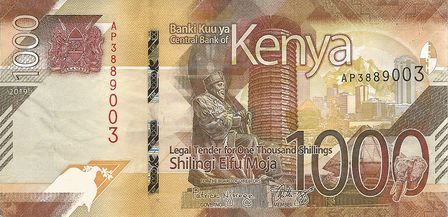

- Main Colour: Brown
- Obverse: Coat of arms of Kenya; Statue of President Jomo Kenyatta; Kenyatta International Convention Centre; Elephant
- Reverse: “Governance” (Parliament building, Nairobi)
- Watermark: Lion’s head and electrotype 1,000
These banknotes are designed to showcase various aspects of Kenya’s economy, from its focus on sustainable energy and agriculture to its tourism industry and governance.
Exchange Rate
The Kenyan Shilling (KES) continues to be subject to fluctuations in the global currency markets. The exchange rate can vary depending on various factors, including inflation rates, foreign exchange reserves, and trade balance.
To get the most current exchange rates for KES, services such as Google Finance, Yahoo Finance, XE.com, and others provide real-time currency conversion information for KES against currencies like USD, EUR, GBP, and CNY.
The current exchange rate is readily obtainable from services such as those in the table below:


