


The Kenya Standard Gauge Railway (SGR) is a key infrastructure project aimed at modernizing Kenya’s railway system and connecting major cities with neighboring countries. Starting with the Mombasa–Nairobi section in 2017, the railway is expected to link Kenya with Uganda, South Sudan, Rwanda, and beyond, enhancing regional trade and travel. The project is a significant move from the older meter-gauge railway system to a more efficient and modern standard gauge railway.
History and Purpose of the SGR
The Kenya Standard Gauge Railway project was launched to address the inefficiencies of the old meter-gauge system and to facilitate economic growth by improving transport for passengers and freight. The railway will also serve as a regional connector, linking Kenya to Uganda, Rwanda, and other East African countries. Initially financed by the Chinese Exim Bank, this ambitious project seeks to create better connectivity, stimulate trade, and boost tourism across the region.
Key Sections of the Kenya Standard Gauge Railway
1. Mombasa to Nairobi
The first phase of the SGR connects Mombasa, Kenya’s main port city, to Nairobi, the capital. The Mombasa-Nairobi Standard Gauge Railway spans 609 kilometers (378 miles) and opened in June 2017 for passengers and January 2018 for freight. This section was built by China Road and Bridge Corporation at a cost of US$3.6 billion.
2. Nairobi to Naivasha
The Nairobi–Naivasha section covers a distance of about 120 kilometers (75 miles). Construction began in 2018, and passenger services were launched in October 2019. This section plays a crucial role in linking the main railway network to the Naivasha Inland Container Depot, enhancing cargo capacity for international freight.
3. Naivasha to Kisumu
This upcoming section, extending about 267 kilometers (166 miles) from Naivasha to Kisumu, aims to provide better access to Lake Victoria and Kisumu Port. It will connect major trade hubs in Kenya and is essential for boosting regional trade and commerce. The project is contracted to China Communications Construction Company (CCCC), with financing from China Exim Bank.
4. Kisumu to Malaba
This stretch, which will connect Kisumu to Malaba, will be the final leg that links Kenya to Uganda. The cost of this phase is estimated at KSh. 169 billion (US$1.69 billion), with CCCC once again contracted to handle the construction.
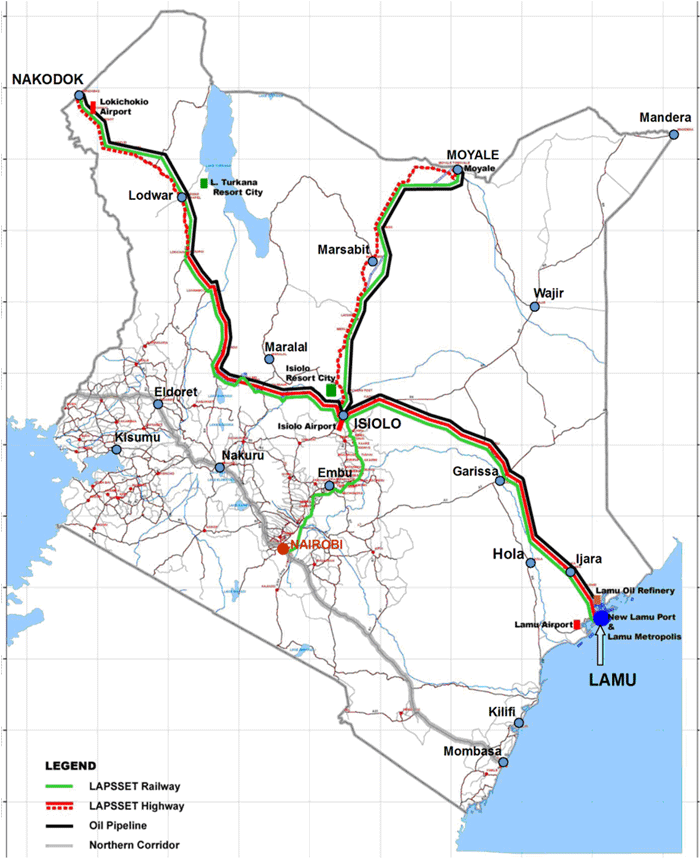
5. Lamu–Lokichar–Nakodok
Part of the Lamu Port and Lamu-Southern Sudan-Ethiopia Transport Corridor (LAPSSET), this section will provide a connection to South Sudan and Ethiopia. Spanning about 1,500 kilometers (932 miles), it is crucial for enhancing trade between East Africa and the Middle East.
Future Plans and Extensions
The Kenya SGR is set to extend beyond the country’s borders, with future phases linking Uganda, Rwanda, and South Sudan. In 2024, Kenya and Uganda committed to jointly funding the extension from Naivasha to Kisumu, and plans are underway to expand the railway further into Kisangani (Democratic Republic of the Congo), Kigali (Rwanda), and Addis Ababa (Ethiopia).
Additionally, the Nairobi–Moyale section, part of the LAPSSET project, will extend the SGR to Ethiopia, strengthening regional connectivity.
Technical Specifications of the SGR
The Kenya Standard Gauge Railway is designed to meet international standards. Some key technical aspects include:
- Track Gauge: 1,435 mm (standard gauge)
- Maximum Speed: 120 km/h (passenger trains), 80 km/h (freight trains)
- Transport Capacity: 20 million tonnes annually
- Electrification: 25 kV AC/50 Hz overhead catenary system
- Train Load: 3500±93 tonnes gross
- Design Capacity: 24.9 million tonnes annually
Environmental and Economic Impact
The Kenya Standard Gauge Railway is expected to significantly reduce transportation costs, improve logistics, and foster regional trade. It will also facilitate the movement of goods between Kenya’s port and landlocked countries like Uganda, South Sudan, and Rwanda.
The project is designed to reduce road congestion, lower the cost of doing business, and contribute to the country’s economic development by improving transport efficiency.
Conclusion
The Kenya Standard Gauge Railway is a transformative project poised to enhance Kenya’s transport infrastructure and boost regional trade. By modernizing rail transport, the SGR offers significant economic opportunities while fostering greater regional integration in East Africa. As future phases unfold, the railway will continue to play a crucial role in connecting Kenya to neighboring countries, ultimately strengthening the East African economy.


