

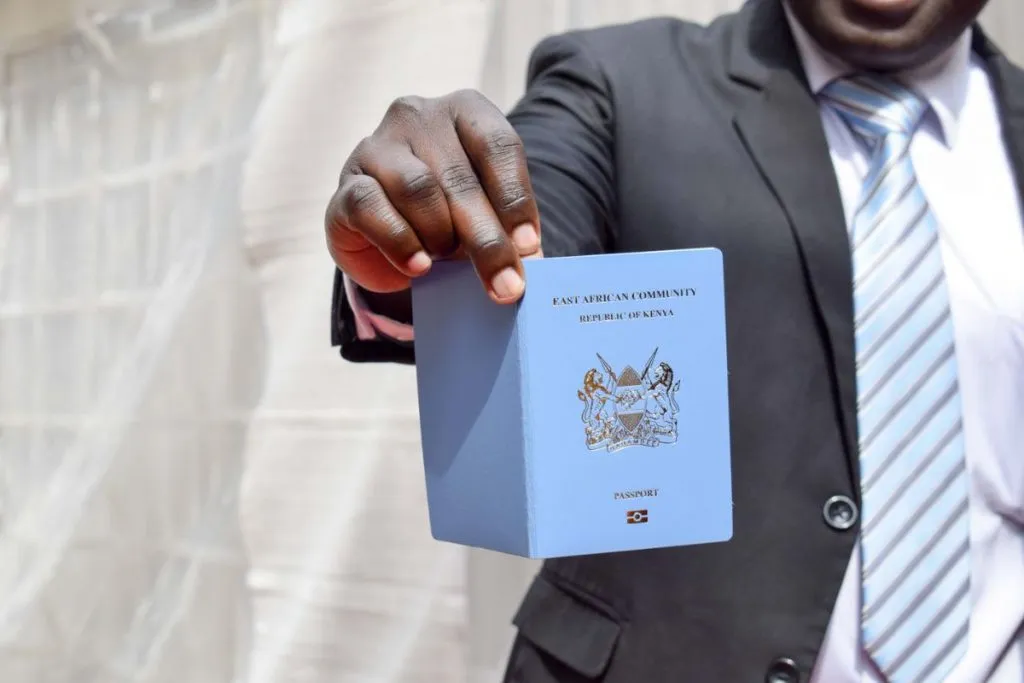
The Kenyan passport is a travel document issued to citizens by the Directorate of Immigration Services for international travel and identification. As of January 15, 2026, the Kenyan passport is ranked 68th globally on the Henley Passport Index, allowing holders visa-free or visa-on-arrival access to 69 destinations.
Types and Appearance
Kenya issues several types of biometric ePassports, which feature a light blue cover (for ordinary) and the East African Community logo.
- Ordinary Passport: Light blue cover, available in three sizes (32, 48, or 64 pages).
- Diplomatic Passport: Maroon cover, issued to accredited diplomats and their dependents.
- East African Passport: Valid for travel only within the East African Community (Tanzania, Uganda, Rwanda, Burundi, etc.).
Application Process
All passport applications must be completed online via the eCitizen portal.
- Register/Login: Create an account on the eCitizen platform.
- Fill Form: Complete the online application form and pay the required fees using mobile money or credit/debit cards.
- Print and Book: Download and print the application form and payment receipts. Book an appointment for biometric enrollment.
- Enrol Biometrics: Attend the appointment in person at a processing center (e.g., Nyayo House in Nairobi, Mombasa, Kisumu, Eldoret) to capture your photo and fingerprints.
Fees and Timelines
| Passport Type | Fee (Kshs) | Pages |
|---|---|---|
| Ordinary “A” Series | 4,550 | 32/34 Pages |
| Ordinary “B” Series | 6,050 | 48/50 Pages |
| Ordinary “C” Series | 7,550 | 64/66 Pages |
| Mutilated Passport | 10,050 | — |
| Lost Passport | 12,050 | — |
- Processing Time: It typically takes at least 10 working days for a first-time passport and 5 working days for renewals once biometrics are captured. For applicants abroad, it can take up to 8–12 weeks.
- Validity: All Kenyan passports are valid for 10 years and are non-renewable; once they expire or run out of pages, a new one must be obtained.
Requirements
- Original and copy of National ID card.
- Original and copy of Birth Certificate.
- Three recent passport-sized photos (2.5 x 2 inches).
- A recommender’s ID card copy (must be a non-relative Kenyan citizen).
- Old passport (for replacements).
What Makes a Passport Strong?
A passport is more than just a document—it determines the ease with which you can study, work, trade, and explore beyond your country’s borders. Passport strength is often evaluated based on the number of countries one can access without a visa, but there are deeper factors influencing a passport’s power.
- Visa-Free Access
The most commonly used metric for passport strength is how many countries one can enter without requiring a visa. Countries with stronger passports offer broader visa-free or visa-on-arrival access to travelers. However, this number only tells part of the story. - Economic Trust
Countries that are perceived as low-risk partners are more likely to grant visa-free access to each other. A strong, stable economy helps in this regard, as wealthier countries are seen as reliable economic partners. This leads to fewer visa restrictions for citizens from wealthier nations, who are often seen as tourists, investors, or business travelers, rather than potential overstayers. - Security Trust
Countries with a history of political stability and good security are often rewarded with more visa leniency. A country’s ability to manage migration and security risks influences how other countries perceive it. - Political Trust
Countries with stable, transparent political systems and strong diplomatic relationships enjoy more visa access. Diplomatic agreements and political alliances can significantly affect passport strength. - Geopolitical Alignment
Visa policies often reflect the strength of diplomatic relations. Countries with friendly international relations benefit from more open travel policies, while adversarial nations face restrictions. Geopolitical shifts can either boost or limit a country’s passport strength.
Kenya’s Passport Strength
Current Standing
Kenya’s passport currently ranks in the middle of global rankings, offering visa-free or visa-on-arrival access to a select number of countries, particularly within Africa, Asia, and the Caribbean. It represents both Kenya’s regional importance and the challenges developing nations face in terms of global mobility.
Key Factors Impacting Kenya’s Passport
- Economic Growth: Kenya’s passport strength could improve with greater economic development. As a lower-middle-income country, economic growth remains a key factor in expanding visa access. Additionally, Kenya’s position as a regional economic and diplomatic hub offers significant potential to boost mobility for its citizens.
- Regional Integration: Kenya’s role within the East African Community (EAC) and broader African integration efforts can gradually ease travel within the continent, improving the perception of Kenyan passport holders.
- Security Perception: Despite the country’s general stability, Kenya faces challenges with recurring security concerns. Political tensions and regional insecurity sometimes affect how Kenyan travelers are perceived, leading to restrictions on mobility.
- Diplomatic Engagement: Kenya’s increasing participation in peacekeeping, diplomacy, and international organizations positively impacts its mobility. Stronger trade and diplomatic partnerships can open doors to more countries for Kenyan citizens.
The Role of Wealth and Stability
Countries with higher income levels typically enjoy more extensive travel freedom due to their economic stability and trusted business environments. Wealthier nations’ citizens are viewed as less likely to overstay visas or seek asylum, which increases their mobility.
However, wealth alone is not enough to determine a country’s global mobility status. Political alliances, diplomatic agreements, and regional security arrangements also play significant roles. This is a critical point for Kenya, where sustained political engagement and regional peacekeeping efforts can bolster the country’s travel freedom.
Kenya’s Mobility Outlook
Kenya’s passport has the potential to improve, especially through regional integration and strategic foreign policy. Investment in secure travel documentation, strengthening ties within the African Union, and advancing diplomatic relationships can enhance the strength of the Kenyan passport.
However, this growth in mobility is not guaranteed. Global shifts in politics, economic instability, or heightened security risks could stall or even reverse progress. The dynamic nature of passport power means that Kenya must continuously engage in diplomatic efforts to maintain or improve its position.
Conclusion
Kenya’s passport sits comfortably in the middle of global rankings, but there is room for improvement. Through sustained economic development, stronger diplomatic ties, and greater regional cooperation, Kenya’s passport could see an upward movement in global rankings. Conversely, geopolitical or security challenges could hinder progress. Ultimately, passport strength is a fluid measure influenced by several interrelated factors, and Kenya’s future in this regard will depend on how effectively it navigates global relationships and regional stability.


