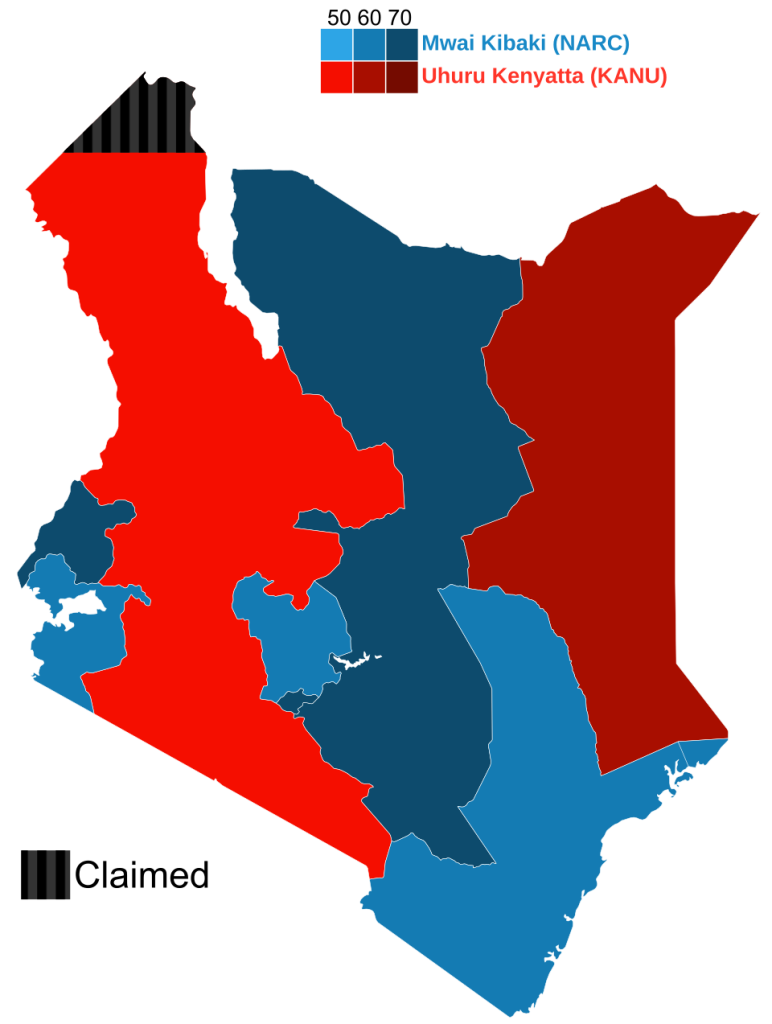


The 2002 Kenyan general election, held on 27 December 2002, was a significant event in the nation’s political history. It marked the end of Kenya African National Union (KANU)‘s dominance, which had been in power since independence in 1963. The election saw Mwai Kibaki of the National Rainbow Coalition (NARC) secure a resounding victory, defeating Uhuru Kenyatta of KANU, and Simeon Nyachae of FORD-People. With a voter turnout of 57.18%, the election ended Daniel arap Moi‘s 24-year rule as president, as he was constitutionally barred from seeking a third term. This election is considered Kenya’s first truly free and fair election since independence.
Background to the Election
The 2002 elections were historic in several ways. President Daniel arap Moi, who had led the country for over two decades, was constitutionally barred from running for a third term, as per Kenya’s new constitution. Initially, some of his supporters pushed for a constitutional amendment to allow him to run again, but Moi chose to retire gracefully and supported Uhuru Kenyatta, the son of Kenya’s first president, as his successor.
However, the decision to back Uhuru Kenyatta led to discontent within KANU, particularly among other presidential aspirants. A faction of these aspirants, including Raila Odinga, Charity Ngilu, and Martha Karua, left KANU and formed the Liberal Democratic Party (LDP). In the meantime, Mwai Kibaki, leader of the Democratic Party (DP), formed an alliance with the LDP and several other opposition parties to create the National Rainbow Coalition (NARC).
On 14 October 2002, at a rally in Uhuru Park, Kibaki was officially nominated as the NARC candidate after Raila Odinga famously declared, “Kibaki Tosha!” (“Kibaki is the one!”). This announcement galvanized the opposition and marked a pivotal moment in the election campaign.
Election Results
Presidential Election
The presidential race was primarily contested between Mwai Kibaki of NARC, Uhuru Kenyatta of KANU, and Simeon Nyachae of FORD-People. Kibaki emerged victorious with 62.20% of the vote, securing 3,646,277 votes. Uhuru Kenyatta finished second with 31.32% and 1,835,890 votes, while Simeon Nyachae garnered 5.89%.
Here are the official results:
| Candidate | Party | Votes | Percentage |
|---|---|---|---|
| Mwai Kibaki | National Rainbow Coalition | 3,646,277 | 62.20% |
| Uhuru Kenyatta | Kenya African National Union | 1,835,890 | 31.32% |
| Simeon Nyachae | FORD–People | 345,152 | 5.89% |
| Others | Various | 24,524 | 0.42% |
The total number of valid votes was 5,861,904, with 114,006 invalid votes.
National Assembly Results
The election also involved the election of members of the National Assembly. The National Rainbow Coalition (NARC) dominated the National Assembly, securing 125 seats out of 222. Other significant parties included KANU, which won 64 seats, and FORD-People, which won 14 seats. The National Rainbow Coalition‘s success in the National Assembly ensured it had the necessary majority to push forward its agenda under Kibaki’s leadership.
Here are the results by party:
| Party | Seats | Seats Change |
|---|---|---|
| National Rainbow Coalition | 125 | +69 |
| Kenya African National Union (KANU) | 64 | -43 |
| FORD–People | 14 | +11 |
| Other parties | 19 | – |
Key Political Figures
- Mwai Kibaki: The leader of NARC, who won the presidential election in a landslide. His victory marked the end of KANU’s long-standing rule and the start of a new political era in Kenya.
- Uhuru Kenyatta: The KANU candidate and son of Kenya’s first president. His defeat was significant, as he was seen as the heir to the KANU legacy.
- Simeon Nyachae: A former cabinet minister and the leader of FORD–People, who secured a third-place finish in the election.
The End of KANU’s Rule
The 2002 election marked a dramatic turning point in Kenya’s political history. KANU, which had been in power since 1963, was decisively defeated. The election results reflected widespread dissatisfaction with the long rule of President Moi, who had presided over a period of political repression and economic stagnation. The NARC alliance, under the leadership of Mwai Kibaki, represented a fresh alternative, and Kibaki’s victory symbolized the triumph of democracy over one-party rule.
Conclusion
The 2002 Kenyan general election remains one of the most significant elections in Kenya’s history. It marked the end of KANU’s nearly four-decade rule, ushering in a new era of democratic governance. The success of Mwai Kibaki and the National Rainbow Coalition was a testament to the Kenyan people’s desire for change and progress. It also demonstrated the growing strength of opposition coalitions in Kenya’s multi-party democracy.