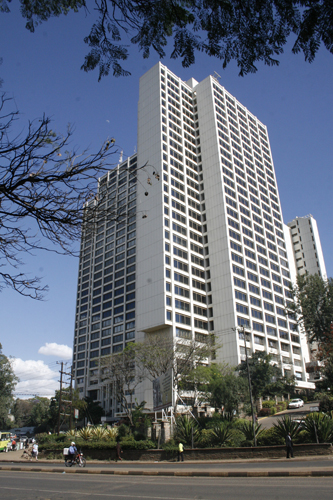


Standing at 103 meters (337 feet) in Nairobi’s Upper Hill area, Social Security House, commonly known as the NSSF Building, is a symbol of Kenya’s post-independence ambition and urban development. Completed in 1973, the skyscraper was Kenya’s tallest building at the time, surpassing even the iconic Nairobi Hilton. For over five decades, it has played a central role in the city’s commercial landscape and remains a key asset in the National Social Security Fund’s (NSSF) real estate portfolio. Today, as the headquarters of NSSF, it houses several government offices and continues to serve as a vital link in the country’s social protection framework.
In an era when Nairobi’s skyline was dominated by much shorter buildings, Social Security House was a defining structure, symbolizing Kenya’s rapid development in the 1970s. Its architecture, functional design, and central location in Upper Hill contributed to its role as one of the city’s most important commercial and governmental buildings. As Nairobi continues to grow and evolve, Social Security House stands as both a historical marker and a beacon of progress in Kenya’s urban landscape.
Design and Architecture: A Monument of Modernity
Social Security House was designed in the modern architectural style, which was reflective of global trends at the time. With 28 floors and a sleek, functional design, the building was a pioneering structure in Nairobi’s commercial real estate market. The building’s simple yet elegant lines exemplify the modernist approach, favoring minimalism and functionality. It was constructed with a focus on maximizing office space while ensuring that the structure could house both government departments and private offices efficiently.
When it was completed, Social Security House stood as the tallest building in Kenya, a status it held for several years. The building’s height and design made it an architectural landmark, setting a new standard for office space in the city. The building’s strategic location on Bishops Road in Upper Hill further cemented its importance, as the area was quickly becoming a hub for businesses and government offices.
At the time, the building’s height and modern design represented the forward-thinking ambitions of Kenya’s leadership, which sought to transform Nairobi into a modern, global city. Its significance is not only in its height but also in the way it reflected the aspirations of an emerging, post-independence economy.
Ownership and Function: NSSF’s Headquarters
Social Security House is owned by the National Social Security Fund (NSSF), Kenya’s largest social security provider. The building serves as the headquarters for NSSF, housing various government offices, including the Ministry of Labour and Social Protection and the State Department for Social Protection. These offices oversee crucial social protection initiatives, such as retirement benefits and welfare programs for workers across Kenya.
As a major asset in the NSSF’s real estate portfolio, Social Security House accounts for nearly 39% of the fund’s property value as of 2025. This speaks to the building’s continued importance not only as a government office but also as a financial cornerstone for the NSSF. The tower is central to the fund’s operations, with its strategic location and modern amenities allowing for the efficient delivery of services to the public.
Additionally, Social Security House also houses private offices and banking facilities, which contribute to its status as a key business address in Nairobi. The building’s blend of public and private tenants ensures a steady flow of activity and provides a variety of services to those working within its walls.
Modern Amenities and Accessibility
Social Security House is equipped with amenities that enhance both the functionality and comfort of its occupants. The building features ample parking, including ramps and elevators designed to accommodate people with disabilities (PWDs), ensuring that the space is accessible to all. The building’s design incorporates modern technology and efficient space planning to meet the needs of a diverse range of tenants.
Despite its age, the building remains an essential piece of Nairobi’s commercial infrastructure. Its design focuses on practicality, ensuring that office spaces are flexible and adaptable to the needs of various tenants. The integration of modern facilities with classic architectural elements ensures that the building continues to meet the expectations of businesses and government entities today.
Future Development: The Rise of NSSF’s Twin Tower Complex
Looking ahead, the National Social Security Fund is embarking on a new development project that will further solidify its position in Nairobi’s skyline. In early 2026, NSSF announced plans to develop a twin-tower complex at the junction of Uhuru Highway and Kenyatta Avenue in Nairobi’s CBD. This ambitious project will feature Tower A, which will rise to 60 storeys (approximately 260 meters), making it the tallest building in East Africa once completed. Tower B, at 35 storeys, will complement the larger tower, further enhancing NSSF’s real estate portfolio.
This new development signals NSSF’s growing influence in Kenya’s commercial real estate market. With its commitment to creating world-class infrastructure, NSSF is positioning itself at the forefront of Nairobi’s urban transformation. The twin towers will undoubtedly become iconic structures in the city, setting new standards for modern office space and offering state-of-the-art amenities to meet the needs of businesses in an increasingly competitive market.
Skycraper Details for Social Security House:
- Height: 103 m (337 ft)
- Floors: 28
- Structural Form: Skyscraper
- Main Usage: Commercial office and government offices
- Status: Completed
- City: Nairobi
- Country: Kenya
- Source: Deborahwando.co.ke
Conclusion:
Social Security House, also known as the NSSF Building, remains one of Nairobi’s most significant architectural landmarks. From its completion in 1973 to its continued use as a major hub for both government and corporate tenants, it has served as a cornerstone of Kenya’s social and economic infrastructure. As Nairobi evolves, the building stands as a symbol of the city’s growth, modernity, and aspirations. With future developments on the horizon, including NSSF’s twin tower complex, Social Security House will continue to be a key part of Nairobi’s skyline and a central hub for Kenya’s economic activities.