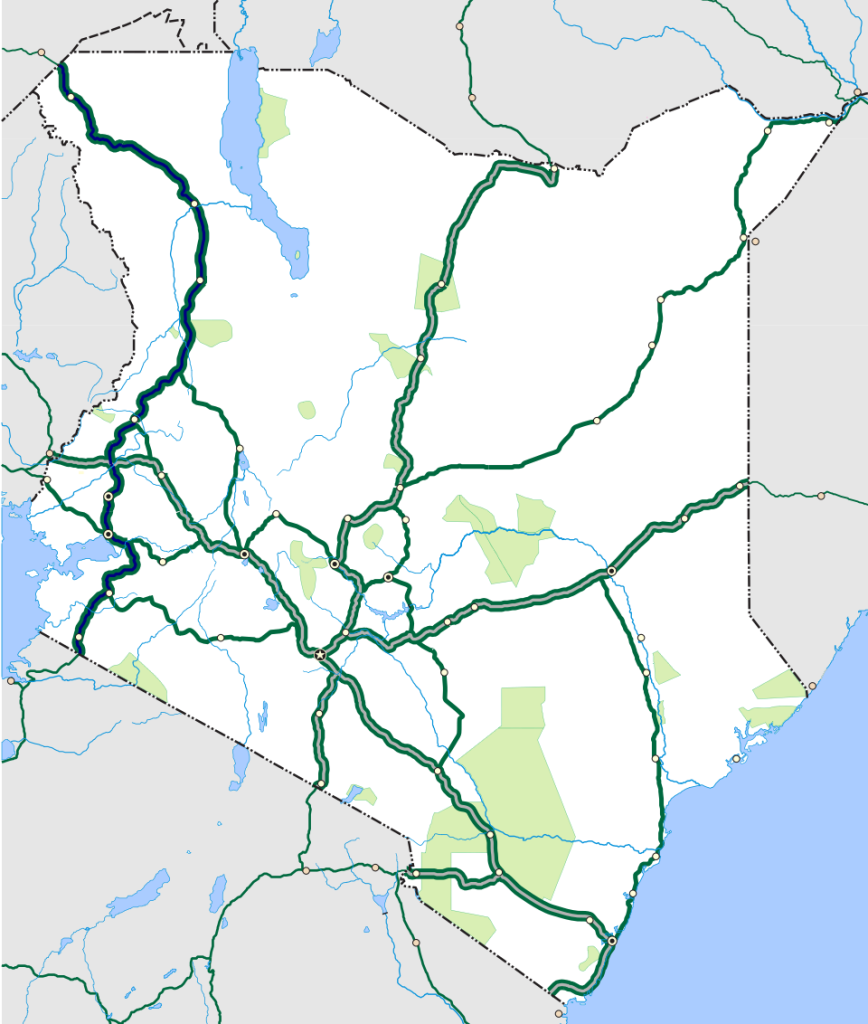


The A1 road in Kenya is one of the country’s most important north–south highways, forming a continuous transport corridor from the Tanzanian border in the south to the South Sudan border in the north. It plays a vital role in regional trade, internal mobility, and national integration by linking western Kenya to northern frontier regions that were historically remote and underserved.
Running through fertile agricultural zones, major urban centers, and arid pastoral regions, the A1 road Kenya connects communities with vastly different economic activities. From cross-border trade at Isebania to humanitarian and logistics hubs near Lokichokio, the highway supports commerce, security operations, and social interaction across multiple counties. Over the past decade, sustained government investment and donor-backed projects have transformed large sections of the road, improving safety and reducing travel time.
Overview of the A1 road in Kenya
The A1 road Kenya stretches from Isebania at the Kenya–Tanzania border to Lokichokio near South Sudan. The road is maintained by the Kenya National Highways Authority and forms part of the national A-class highway system.
Geographically, the highway cuts across western Kenya and the Rift Valley fringe before entering Turkana County. Its alignment makes it a strategic alternative to the central corridor routes, particularly for trade linking East Africa to South Sudan and parts of the Horn of Africa.
Road upgrades and development projects
Several sections of the A1 road Kenya have undergone major rehabilitation and upgrading to meet modern highway standards. One of the most significant projects covered the stretch between Isebania and Ahero. This 172-kilometer section was upgraded between 2016 and 2023 with improved surfacing, road markings, safer pedestrian crossings, feeder-road connections, and modern signage. The upgrades significantly enhanced road safety and boosted trade efficiency in Migori, Kisii, and Kisumu regions.
Further north, large-scale improvements have targeted the Turkana section of the highway. A 40-kilometer stretch between Lokichar and Loichangamatak has been upgraded by China State Engineering Corporation, while an 80-kilometer section between Lokitaung and Lodwar has been handled by the China City Construction Group. These works were funded through a major World Bank-supported national roads program, aimed at opening up northern Kenya and improving access to services and markets.
Towns and urban centers along the A1 road Kenya
The A1 road Kenya passes through a long chain of towns and cities, each playing a distinct economic or administrative role. From south to north, the main towns along the highway include:
- Isebania, a key border crossing and trade hub with Tanzania
- Migori, supporting agriculture and cross-border commerce
- **AwendoRongo- Kisii, a densely populated highland city
- **Oyugis rural areas
- **Sondu
- Ahero, a junction town linking western Kenya
- Kisumu, a major lake port and commercial hub
- **Vihiga
- Kakamega, a regional administrative center
- **Webuye transport links
- Kitale, at the heart of maize production
- **Makutano
- Lokichar, near oil exploration areas
- Lodwar, the administrative capital of Turkana
- Kakuma, close to the Kakuma Refugee Camp
- Lokichokio, a logistics and humanitarian gateway
The section between Ahero and Kisumu is shared with the B1 road, which branches eastward toward Nakuru, further strengthening regional connectivity.
Economic and strategic importance
The A1 road Kenya is more than just a transport route. It is a development corridor that supports agriculture, cross-border trade, humanitarian logistics, and national security. In western Kenya, the road enables farmers to move produce such as sugarcane, maize, tea, and bananas to markets. In northern Kenya, it connects pastoral communities to health, education, and administrative services.
Strategically, the road is critical for trade and aid movement between Kenya and South Sudan. Towns like Lokichokio and Kakuma have long served as staging points for humanitarian operations, and improved road infrastructure has made these activities more efficient and reliable.
The role of the A1 road in regional integration
By linking Tanzania, Kenya, and South Sudan, the A1 road Kenya supports broader East African regional integration. It complements other international corridors and reduces overreliance on central routes through Nairobi. As upgrades continue, the highway is expected to attract more investment, improve road safety, and strengthen Kenya’s role as a regional transport hub.
The A1 road Kenya therefore stands as a critical piece of national infrastructure, shaping economic growth, social connectivity, and cross-border cooperation across some of the country’s most diverse regions.