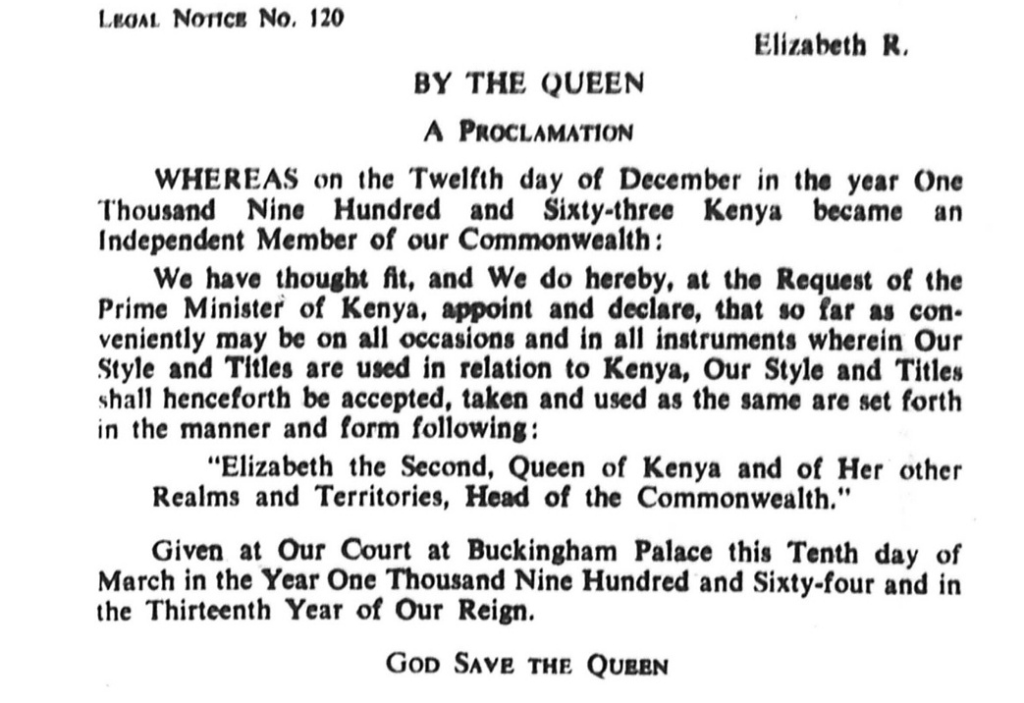


Queen Elizabeth II served as the Queen of Kenya from 1963 to 1964, during the brief period when Kenya was a sovereign state with a constitutional monarchy. The monarchy was part of the larger British Commonwealth realm, and Elizabeth II was also the sovereign of the United Kingdom and other territories. However, Kenya’s monarchy lasted only a year, and the country soon transitioned into a republic. This article explores the Queen’s role, the brief existence of the Kenyan monarchy, and its subsequent abolition.
Formation of Kenya’s Monarchy: Independence in 1963
Kenya gained independence from the United Kingdom through the Kenya Independence Act of 1963, which established the country as a sovereign state. As per the provisions of the act, Queen Elizabeth II became the Queen of Kenya, marking the country’s transition from a British colony to an independent nation. Prince Philip, the Duke of Edinburgh, represented the Queen at Kenya’s independence celebrations, and he also opened the first session of the Kenyan Parliament in December 1963 on her behalf.
While the Queen was the head of state, her constitutional roles were largely ceremonial, and her powers were delegated to the Governor-General of Kenya, who was appointed by the Queen on the advice of Kenya’s Prime Minister. Malcolm MacDonald served as the Governor-General throughout this period. The Governor-General had the authority to exercise the executive powers of the monarch, including giving Royal assent to all bills passed by Parliament.
The End of the Monarchy: Transition to a Republic
In 1964, Kenya adopted a new constitution, which marked the official end of the monarchy. The office of the Governor-General was abolished, and Kenya became a republic within the Commonwealth, with a president as the head of state. This shift in governance ended Queen Elizabeth II’s reign over Kenya, making her role as Queen of Kenya extremely brief—lasting only one year.
Queen Elizabeth II’s Visits to Kenya
Before becoming Queen, Elizabeth II was in Kenya in 1952 when she received the news of her father, King George VI’s death, while staying at Treetops Hotel in Aberdare National Park. This moment in history is significant as it marked Elizabeth’s accession to the throne. The Mombasa tusks, a famous monument on Moi Avenue in Mombasa, were initially constructed to commemorate her visit in 1952.
Following Kenya’s independence, the Queen made state visits to Kenya in 1972 and 1991. Her most notable visit occurred in 1983, when she visited as a guest of President Daniel arap Moi, following Kenya’s transition into a republic.
Queen Elizabeth II’s Titles and Style
As Queen of Kenya, Elizabeth II held several formal titles. These included:
- 12 December 1963 – 10 March 1964: “Elizabeth the Second, by the Grace of God, of the United Kingdom of Great Britain and Northern Ireland and of Her other Realms and Territories Queen, Head of the Commonwealth, Defender of the Faith”
- 10 March 1964 – 12 December 1964: “Elizabeth the Second, Queen of Kenya and of Her other Realms and Territories, Head of the Commonwealth”
These titles reflect her role as both the Queen of Kenya and as part of a larger constitutional monarchy within the Commonwealth.
Conclusion: The Legacy of the Queen of Kenya
Queen Elizabeth II’s reign over Kenya was short-lived, lasting only a year before the country transitioned to a republic. This period in Kenya’s history highlights the nation’s complex relationship with the British monarchy and the significant constitutional changes that followed independence. Despite the monarchy’s brief presence in Kenya, Elizabeth II’s influence remains embedded in the country’s history, especially through her visits and the cultural markers left behind, such as the Mombasa tusks.